
As 2026 unfolds, the conversation about Human Capital Management (HCM) technology has evolved well beyond feature checklists. For HR, IT, and Finance leaders, the challenge is no longer simply selecting tools; it is defining an HCM technology strategy that drives measurable business outcomes, maximizes return on investment (ROI), and enables the organization to continuously adapt as business needs change.
Our evaluations of diverse HCM technology stacks reveal a consistent pattern: three strategic imperatives will define the coming year. These three imperatives should anchor technology planning and guide decisions about whether, and how, to evaluate new technology.
1. AI Is Not an Add-On: Enabling Talent Fluidity
Generative AI laid the groundwork, but 2026 marks the shift toward Agentic AI, autonomous systems capable of coordinating multi-step tasks across platforms and processes. This shift represents the most significant inflection point for the HCM tech stack in years, particularly in how organizations understand and deploy their workforce.
At the center of this shift is Talent Fluidity.
I think of Talent Fluidity as an organization’s ability to quickly understand, deploy, and develop its workforce based on verified, current skills rather than static job titles, which enables continuous alignment between talent and evolving business goals.
Two critical changes underpin this shift:
- From Tools to Agents
Leading Enterprise vendors like Workday, Oracle, and SAP SuccessFactors are moving beyond simple AI copilots toward full AI agents that can manage complex, end-to-end HR processes, such as proactive talent sourcing, workforce planning simulations, or skills-based project staffing. This evolution dramatically raises the bar for data governance, integration, and process clarity. - Solving the “We Don’t Know What We Have” Problem
Many organizations remain constrained by obsolete talent data, relying on static job descriptions that mask valuable and emerging skills. In our experience, this is one of the biggest barriers to agility. A unified, continuously updated skills inventory enables organizations to deploy employees to internal projects, development pathways, and future roles based on real capability, not historical job titles.
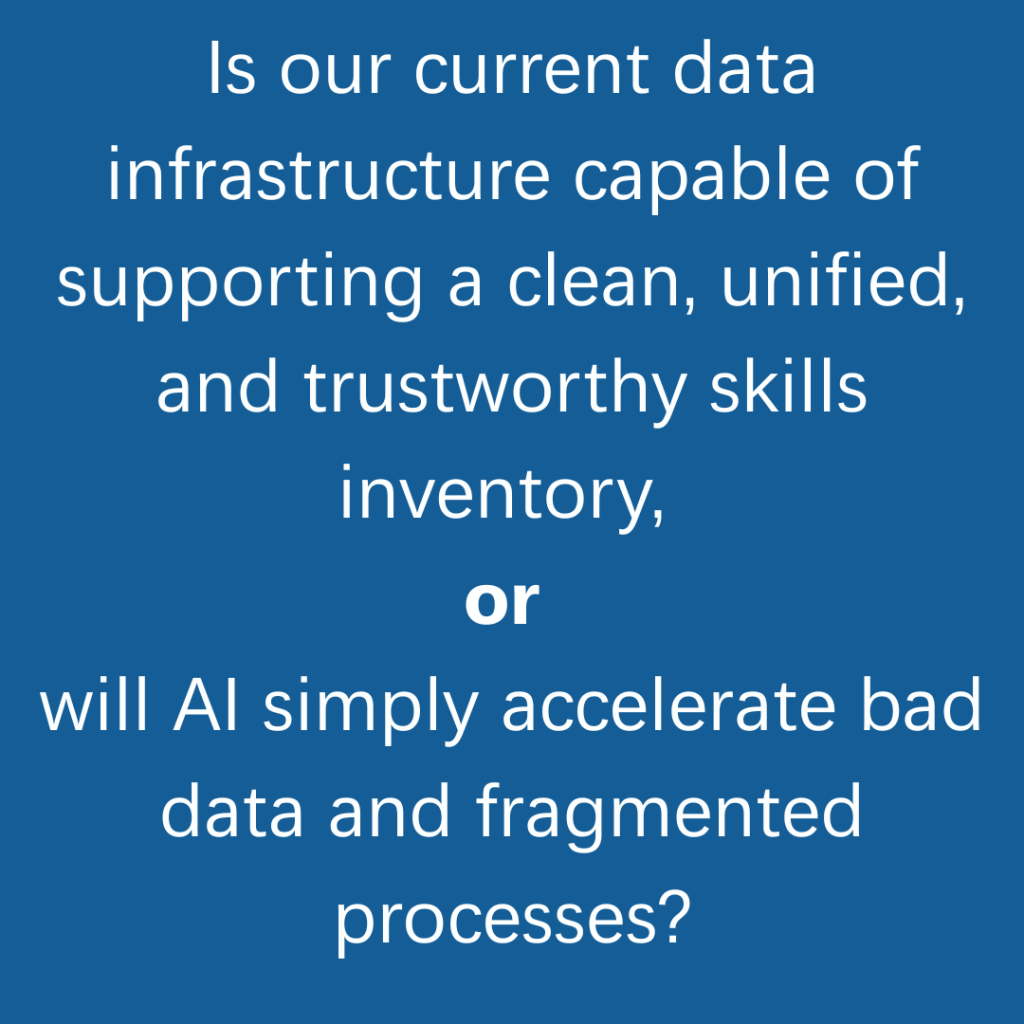
Before investing in advanced AI functionality, executive teams should pause to ask a fundamental question:
2. Prioritizing HCM Interoperability
As AI capabilities expand and hybrid work models persist, confidence in workforce data moving across the enterprise becomes non-negotiable. While consolidation is the right strategy for some organizations, others operate within ecosystems where multiple systems will remain in place for the foreseeable future, often due to specialized business needs. For example, a global manufacturing firm may use a global HCM for its corporate workforce but maintain local systems in diverse regions like Brazil or Germany, allowing it to manage local labor laws and union requirements that a single global solution might not handle natively. In those cases, the challenge is to transform this multi-system landscape into a unified experience; if you are not consolidating, you must invest in seamless, two-way integration.
Beyond Integration to True Interoperability
Point-to-point integrations, direct connections between two solutions, may move data, but they often create hidden silos that undermine decision-making. What leaders need instead is interoperability – secure, governed, and reliable data flow that ensures every function is working from the same real-time workforce reality.
A common pitfall to avoid is treating system integration as a one-time project, rather than assigning ongoing accountability for maintaining the critical links between platforms. This lack of operational ownership is a significant risk. Without a dedicated owner, integrations quickly unravel, turning what should be a connected ecosystem into fragmented chaos.
For your 2026 planning cycle, leaders must move beyond simply confirming that systems can connect. Instead, the evaluation must focus on long-term governance and risk mitigation by asking:
- Data Integrity & Trust: Who is the accountable business owner ensuring our workforce data is consistent, accurate, and trustworthy across every system?
- Operational Health: What is the dedicated process for continuously monitoring data quality and fixing errors before they impact business decisions?
- Future Readiness: Does our current system architecture actively support our future goals, specifically the ability to use AI and advanced analytics to improve talent decisions?
3. Designing for Employee Retention Through Experience
The ultimate ROI of a modern HCM tech stack is a productive, engaged, and retained workforce. In 2026, organizations must intentionally design employee experience across the entire employee lifecycle and orchestrate it through the HCM ecosystem—not treat it as a collection of programs or benefits.
Hyper-Personalization at Scale
AI-enabled experiences are moving beyond generic self-service toward context-aware support, delivering personalized learning recommendations, career guidance, or next-best-action prompts directly within employees’ daily workflows. Done well, this reduces friction and accelerates decision-making. Done poorly, it introduces noise and mistrust.
Continuous Listening with Purpose
Technology is enabling “always-on” listening models paired with predictive analytics to surface burnout and attrition risks earlier. However, the shift is not about collecting more data; it is about acting on it transparently and responsibly. Trust, governance, and change management remain just as critical as the technology itself.
Organizations that succeed will treat employee experience as a designed system, not a series of disconnected tools.
Final Thoughts: Planning Your Next Move
In 2026, organizations will move beyond viewing HCM technology as a back-office platform. HCM systems will be a central driver of enterprise strategy, organizational redesign, and long-term business viability. Leaders who succeed will move beyond departmental budgets and vendor feature comparisons, instead viewing their HCM environment as a single, interconnected engine.
Navigating vendor claims, assessing current-state capabilities, and building a realistic roadmap across people, process, data, and technology is complex, particularly in environments shaped by years of incremental decisions.
Ensure your next HCM investment isn’t just another software purchase, but a strategic move. Start your evaluation and selection journey with HRchitect. At HRchitect, we work with organizations to facilitate these strategic conversations. Learn more about how we deliver value—explore our latest case studies to see how we help leaders modernize processes and select best-fit technology. The goal is not just to modernize, but to ensure HCM investments deliver real business value in 2026 and beyond.
Contact us today to talk to an expert.
About the Author

Renee is a Senior Strategic Services Consultantat HRchitect. She coaches global clients through a process of strategic thinking, aligning technology and processes to their business goals and desired future HR Service Delivery model. She also supports her clients through formal evaluation processes that culminate in vendor-of-choice selections. Renee is a Certified Professional with the Society for Human Resource Management (SHRM) and has been invited to speak at conferences and industry events in Boston. Renee is a co-author of HRchitect’s Guide to HCM Technology.
Learn more about Renee on LinkedIn

Further Reading (Buy your copy today): HRchitect’s Guide to HCM Technology